> For the complete documentation index, see [llms.txt](https://docs.radiant.capital/radiant/llms.txt). Markdown versions of documentation pages are available by appending `.md` to page URLs; this page is available as [Markdown](https://docs.radiant.capital/radiant/project-info/markets/borrow/interest-rate-model.md).
# Interest Rate Model
Mitigating liquidity risk through the borrow interest rate model
## Interest Rates (APY) & Utilization
Radiant's interest rate algorithm is calibrated to manage liquidity risk and optimize utilization. The borrow interest rates are derived from the utilization rate U.
U is an indicator of the availability of capital within the pool. The interest rate model manages liquidity risk in the protocol through user incentives to support liquidity:
* When capital is available: low-interest rates to encourage borrowing
* When capital is scarce: high-interest rates encourage debt repayments and additional supply of capital
## Interest Rate Model
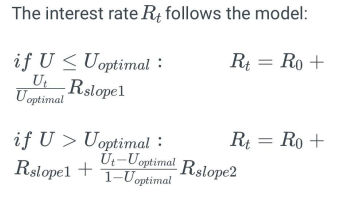
Liquidity risk materializes when utilization is high, and this becomes more problematic as U gets closer to 100%. To tailor the model to this constraint, the interest rate curve is split into two parts around an optimal utilization rate $$U\_{optimal}$$. Before $$U\_{optimal}$$the slope is small, after it begins rising sharply.
Since these aspects of the Radiant smart contracts are influenced by Aave, please refer to their documentation for further details of the interest rate model:
{% embed url="" %}